

Strong writing is not built on vocabulary alone. It is built on sentence structure. One of the most important structures every serious writer must master is the complex sentence. Whether you are writing essays, blogs, academic papers, or professional emails, complexes allow you to express ideas clearly, logically, and persuasively.
A complex sentence does more than connect words. It connects thoughts. It shows cause and effect, contrast, conditions, time, and reason. Without complex sentences, writing becomes flat, repetitive, and immature. With them, your writing gains depth, rhythm, and authority.
In this guide, you will learn exactly what a sentence is, how it works, and how to write one correctly. You will explore real-world sentence structure in English examples, practical structures, common mistakes, and professional writing tips. By the end, you will not only recognize sentence structure in English you will confidently use them to write like a pro.
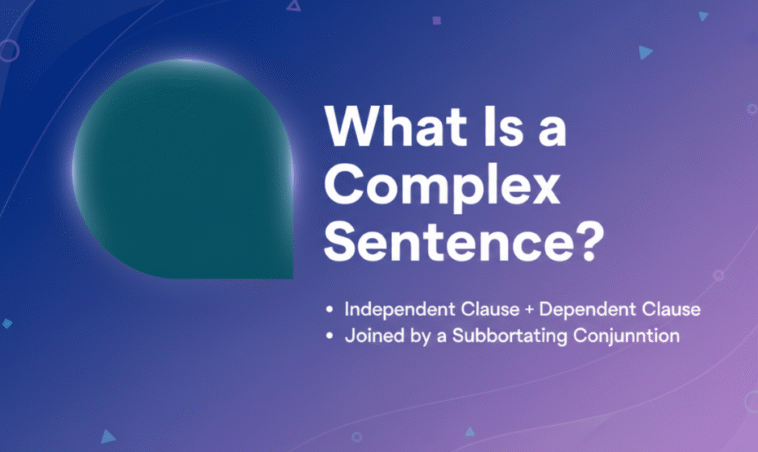
What Is a Complex Sentence?
A complex sentence is a sentence that contains one independent clause and at least one dependent clause.
An independent clause can stand alone as a complete thought.
A dependent clause cannot stand alone. It needs the independent clause to make sense.
Example:
“I stayed home because it was raining.”
“I stayed home” is the independent clause.
“because it was raining” is the dependent clause.
Together, they form a complex sentence.
They are powerful because they allow you to explain relationships between ideas instead of listing them in short, disconnected statements.
Why Complex Sentences Matter in Writing
Professional writing depends on clarity and flow. Complex sentences allow writers to show how ideas are connected.
They help you:
• Explain reasons and results
• Show contrast and comparison
• Express conditions and consequences
• Add depth and detail
• Improve readability and style
Without complex sentences, writing becomes choppy. Readers feel like they are reading notes instead of natural language.
Independent vs Dependent Clauses Explained Simply
Before writing a complex sentence, you must understand clauses.
An independent clause expresses a complete idea.
Example: “She finished her work.”
A dependent clause adds information but cannot stand alone.
Example: “because she felt confident”
When combined:
“She finished her work because she felt confident.”
The dependent clause often begins with a subordinating conjunction such as:
because, although, since, while, when, if, after, before, unless, whereas, though
These words signal that a complex sentence is forming.
Common Types of Complex Sentences
Complex sentences appear in many forms depending on what relationship they show.
Cause and Effect
These sentences explain why something happens.
Example:
“He missed the meeting because his flight was delayed.”
They are common in academic writing, reports, and explanations.
Time Relationships
These show when something happens.
Example:
“After the storm ended, the streets quickly filled with traffic.”
Time-based complex sentences are essential for storytelling and process writing.
Conditions
These show that one action depends on another.
Example:
“If you practice daily, your writing will improve.”
They are widely used in instructions, advice, and persuasive writing.
Contrast
These highlight differences or unexpected outcomes.
Example:
“Although she was nervous, she delivered a confident speech.”
Contrast adds depth and emotional impact.
Purpose
These explain why something is done.
Example:
“He spoke quietly so that he would not disturb anyone.”
Purpose clauses improve clarity and logic.
Complex Sentence Examples for Everyday Writing
“I started a new routine because my productivity was declining.”
“Although the project was difficult, the results were worth the effort.”
“When the deadline approached, the team increased its focus.”
“If you want stronger writing, you must study sentence structure.”
“Since she changed her study habits, her grades have improved.”
Each of these sentences connects ideas logically instead of separating them into weak statements.
How to Write a Complex Sentence Step by Step
Writing a complex sentence becomes easy when you follow a clear method.
Step 1: Write a simple independent clause
Example: “The presentation succeeded.”
Step 2: Add a dependent clause to explain or expand
Example: “because the speaker prepared thoroughly”
Step 3: Combine them correctly
“The presentation succeeded because the speaker prepared thoroughly.”
That is a completely complex sentence.
You can also place the dependent clause first.
“Because the speaker prepared thoroughly, the presentation succeeded.”
Both are correct. Only the punctuation changes.
Punctuation Rules You Must Know
When the dependent clause comes first, use a comma.
“Although he was tired, he finished the assignment.”
When the independent clause comes first, no comma is needed.
“He finished the assignment although he was tired.”
Incorrect punctuation is one of the most common mistakes in complex sentences.
Complex Sentence Examples for Academic Writing
Academic writing relies heavily on complex sentence structure.
“Although many studies support this theory, further research is required.”
“Because language shapes perception, sentence structure plays a critical role.”
“When the data was analyzed, significant trends emerged.”
“Since the sample size was limited, the results should be interpreted cautiously.”
These examples show professionalism, logic, and critical thinking.
Complex Sentences in Professional Communication
Complex sentences make professional writing more precise.
“While we appreciate your interest, the position has already been filled.”
“If the documents are submitted today, processing will begin immediately.”
“Because the market has shifted, our strategy must adapt.”
Professional communication depends on conditional, contrast, and cause-and-effect structures.
How Complex Sentences Improve Style
Good writing flows. It does not stumble.
This allows writers to vary rhythm and length. They combine short thoughts into meaningful patterns.
Instead of writing:
“I was tired. I continued working. The deadline was near.”
Write:
“Although I was tired, I continued working because the deadline was near.”
One sentence now expresses emotion, cause, and decision.
This is professional-level writing.
Micro Case Insight: Student Writing Improvement
Students who learn complex sentence structure often see immediate improvement.
Short, repetitive writing:
“I studied. I failed the test. I was confused.”
Rewritten with complex sentences:
“Although I studied, I failed the test because my approach was ineffective.”
The second version shows reasoning and reflection.
Pros and Cons of Using Sentences
Benefits
Sentences improve clarity, logic, flow, and persuasion. They allow writers to express layered ideas and sound more natural.
Risks
Overusing complex sentences can make writing dense or confusing. When too many clauses stack together, readers lose track of meaning.
Professional writing balances simple, compound.
Complex sentences should enhance writing, not overwhelm it.
Common Mistakes with Complex Sentences
Many writers misuse sentences in predictable ways.
One common mistake is writing fragments.
“Because I was tired.”
This is not a complete sentence.
Another mistake is comma splices.
“Because I was tired, I went home and slept.”
This incorrectly joins clauses.
Another issue is overloading.
“Although I was tired because I had worked all day while the deadline was approaching since the project was difficult…”
This structure becomes unclear.
Clarity always comes before complexity.
How to Practice Writing
Skill improves through targeted practice.
Start with one idea.
Add one dependent clause.
Read it aloud.
Check punctuation.
Confirm clarity.
Then gradually increase sophistication.
Rewrite simple paragraphs into complex structures. Study how professionals use them in articles, novels, and academic texts.
Complex Sentences vs Other Sentence Types
There are four main sentence types.
Simple sentences have one independent clause.
Compound sentences join independent clauses.
sentences combine independent and dependent clauses.
Compound-complex sentences use multiple of both.
They provide structure without overcrowding.
How Complex Sentences Strengthen Persuasion
Persuasive writing depends on reasoning.
“People should exercise.”
This is weak.
“Because regular exercise improves both mental and physical health, people should make it part of their daily routine.”
Now the sentence persuades me.
Mini Summary: What You Should Remember
A complex sentence contains an independent clause and at least one dependent clause.
It shows relationships between ideas.
It improves clarity, style, and authority.
It requires correct punctuation.
It should be balanced with other sentence types.
Mastering complex sentences transforms writing.
Practical Tip for Writers
When editing your work, highlight sentences that are short and repetitive. Then combine related ideas using subordinating conjunctions.
This technique alone can dramatically raise writing quality.
Conclusion
They are not just grammar tools. They are thinking tools. They allow writers to express cause, contrast, conditions, and conclusions in a way that mirrors how the human mind works.
When you master the complex sentence, you gain control over tone, clarity, and persuasion. Your writing becomes smoother. Your arguments become stronger. Your voice becomes more professional.
Whether you are a student, content creator, academic writer, or business professional, learning to write strong complex sentences is one of the most valuable language skills you can develop.
Practice them. Analyze them. Use them intentionally.
That is how you write like a pro.
FAQs
1. What is a complex sentence?
This contains one independent clause and at least one dependent clause that adds meaning or context.
2. Why is a complex sentence important in writing?
A sentence allows writers to connect ideas, explain relationships, and create smoother, more professional writing.
3. What are some easy complex sentence examples?
“Although it was late, she continued working.”
“I stayed inside because it was raining.”
4. How do you identify a complex sentence?
Look for a complete sentence joined with a dependent clause starting with words like because, although, when, or if.
5. What mistakes should I avoid with complex sentences?
Avoid fragments, comma splices, and overly long sentences that confuse the reader.
6. How often should I use complex sentences?
Use them regularly but mix them with simple and compound sentences for balance and readability.