


Building broad, rounded shoulders is one of the most visible markers of an athletic physique and the lateral raise is the single most effective isolation exercise for sculpting that “3D” look. Whether you’re performing a dumbbell lateral raise, experimenting with the cable lateral raise, or fine-tuning your form in a seated raise, mastering technique is key to unlocking maximum muscle activation and growth.
However, many lifters perform lateral raises incorrectly, swinging weights, using momentum, or targeting the wrong muscle fibers. The result? Shoulder pain, limited gains, and wasted effort.
This complete guide breaks down everything about lateral raises: anatomy, execution, variations, sets, reps, and expert tips to optimize shoulder training. You’ll learn how to choose between dumbbells, cables, and machines and how to use each for maximum deltoid activation and balanced muscle growth.
Let’s build your best shoulders ever one perfect lateral raise at a time.
1. Understanding the Shoulder Anatomy
Before lifting a dumbbell, it’s vital to know what you’re training. The shoulder muscle, or deltoid, has three main heads:
- Anterior Deltoid (Front): Responsible for arm flexion activated heavily in front raises and pressing movements.
- Lateral (Medial) Deltoid: The main target during lateral raises responsible for shoulder abduction (lifting your arm to the side).
- Posterior Deltoid (Rear): Activated during pulling or reverse fly movements.
The lateral deltoid gives width and roundness to the shoulders, creating that sought-after “V-taper” look. Neglecting it can lead to unbalanced development, even if your front delts are strong from pressing exercises like the bench press or overhead press.
2. Why Lateral Raises Are Essential
Unlike compound lifts that involve multiple muscles, lateral raises are isolation movements focusing almost entirely on the side deltoid. This makes them indispensable for:
- Building shoulder width: Adds the illusion of a broader frame.
- Improving symmetry: Balances front and side shoulder development.
- Enhancing pressing strength: A stronger lateral head stabilizes heavy lifts.
- Preventing injuries: Strengthening smaller stabilizers around the shoulder joint.
Most athletes who skip lateral raises eventually face imbalances or shoulder strain, especially from overdeveloped front delts.
3. Dumbbell Lateral Raise – The Classic Variation
Muscles Worked:
- Primary: Lateral deltoid
- Secondary: Upper trapezius, anterior deltoid, supraspinatus
How to Do It Perfectly:
- Start Position:
- Stand upright with feet shoulder-width apart.
- Hold a dumbbell in each hand, palms facing your thighs.
- Slight bend in elbows (about 10–15°).
- Stand upright with feet shoulder-width apart.
- Raise Phase:
- Lift your arms to the sides until they’re parallel to the floor.
- Lead with your elbows, not your hands.
- Exhale during the lift.
- Lift your arms to the sides until they’re parallel to the floor.
- Lower Phase:
- Slowly bring the weights down under control.
- Inhale and avoid letting them drop too fast.
- Slowly bring the weights down under control.
Trainer’s Tips:
- Avoid shrugging; keep shoulders down and relaxed.
- Do not use momentum focus on muscle control.
- Stop at shoulder height to avoid trap dominance.
Recommended Sets & Reps:
3–4 sets of 10–15 reps. Focus on slow tempo (2 seconds up, 3 seconds down).
4. Cable Lateral Raise – Constant Tension, Constant Growth
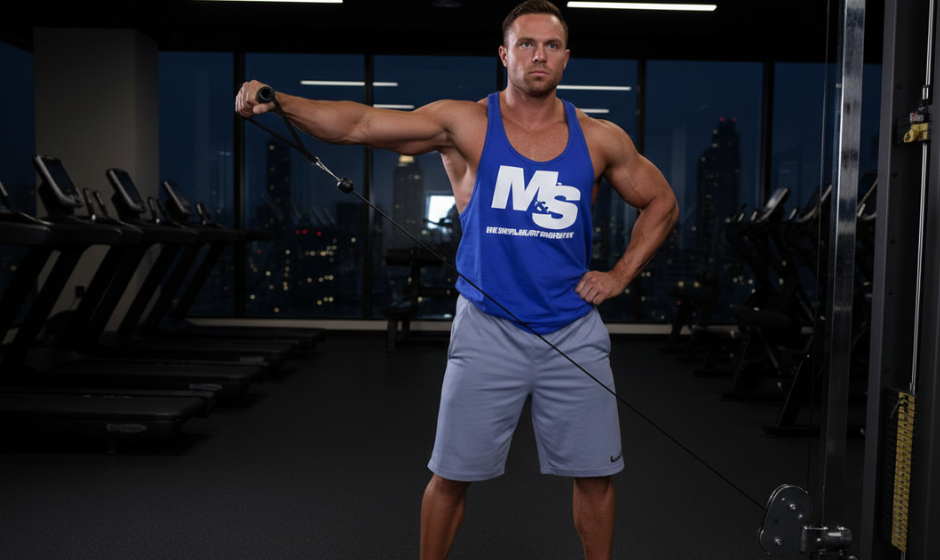
The cable lateral raise offers smoother resistance and constant tension, making it excellent for hypertrophy and joint health.
How to Perform:
- Set the cable to the lowest pulley position.
- Stand side-on to the machine, grabbing the handle with your outer hand.
- With a slight elbow bend, raise your arm laterally until it’s shoulder level.
- Lower slowly, maintaining control throughout.
Why It Works:
- Cables provide resistance throughout the entire range of motion, unlike dumbbells where tension drops at the top.
- Great for fine-tuning the mind–muscle connection.
Best For:
Intermediate to advanced lifters focusing on constant-tension hypertrophy and shoulder definition.
5. Seated Lateral Raise – Pure Isolation
When standing, many people use body momentum to lift heavy weights. The seated raise eliminates this by forcing a strict form.
How to Do It:
- Sit upright with dumbbells resting by your sides.
- Keep your back straight, chest up, and core tight.
- Raise both arms out to the sides until parallel to the ground.
- Pause, then lower slowly under control.
Pro Tip:
Use lighter dumbbells than your standing raises the goal is isolation, not ego lifting.
Benefit:
Perfect for finishing your shoulder workout or doing high-rep burnout sets.
6. Front Raises vs. Lateral Raises
It’s easy to confuse front raises and side lateral raises, but they target different parts of your shoulder.
| Movement | Primary Muscle | Equipment | Benefit |
| Front Raise | Anterior Deltoid | Dumbbell/Barbell/Plate | Builds front shoulder thickness |
| Lateral Raise | Lateral Deltoid | Dumbbell/Cable | Builds width and roundness |
To achieve balanced shoulders, combine both. For example:
- Front Raises: 3 sets of 10 reps
- Lateral Raises: 4 sets of 12–15 reps
This ensures both the front and side heads grow proportionally.
7. Common Mistakes to Avoid
Even small errors can ruin your lateral raises. Here are the most frequent mistakes and how to fix them:
❌ Using Momentum
Swinging weights reduces time under tension.
Fix: Slow the lift and pause at the top for 1–2 seconds.
❌ Shrugging Shoulders
Engages traps instead of delts.
Fix: Keep shoulders down and relaxed.
❌ Going Too Heavy
Overloading forces compensation from other muscles.
Fix: Choose a weight you can control for 12–15 clean reps.
❌ Poor Range of Motion
Stopping too early limits gains.
Fix: Raise arms to at least shoulder height.
8. Lateral Raise Variations for Growth
Mixing up variations keeps your shoulders growing. Try these effective alternatives:
a. One-Arm Dumbbell Lateral Raise
- Focuses on one side at a time, improving mind–muscle connection.
- Allows better form correction.
b. Lean-Away Cable Raise
- Step away from the cable to increase the stretch at the bottom.
- Extends time under tension great for advanced hypertrophy.
c. Machine Lateral Raise
- Perfect for consistent resistance without stabilizing effort.
- Great for beginners or burnout sets.
d. Partial Reps
- Perform 1½ reps per repetition for an insane deltoid pump.
- Ideal finisher technique.
9. Programming Lateral Raises into Your Routine
Beginners (2x per week):
- Dumbbell Lateral Raise: 3 sets × 12–15 reps
- Front Raise: 3 sets × 10–12 reps
Intermediate (3x per week):
- Cable Lateral Raise: 4 sets × 12 reps
- Seated Raise: 3 sets × 15 reps
- Dumbbell Front Raise: 3 sets × 10 reps
Advanced (Push/Pull/Leg Split):
Push Day: Dumbbell Lateral Raises (drop sets)
Pull Day: Rear delt fly
Accessory Day: Cable Lateral Raises with tempo control
The key to growth isn’t just heavy lifting, it’s consistent progression and strict form.
10. Time Under Tension and Tempo Training
For muscle growth, tempo matters as much as load. A controlled, slower lateral raise maximizes mechanical tension.
Example tempo:
- 2 seconds up (concentric)
- 1-second hold
- 3 seconds down (eccentric)
This builds endurance and keeps deltoids under tension longer, essential for hypertrophy.
11. Dumbbell vs Cable Lateral Raises – Which Is Better?
| Feature | Dumbbell | Cable |
| Resistance Curve | Highest at top | Constant throughout |
| Stability | Requires more control | Machine-assisted |
| Convenience | Easy access | Requires cable setup |
| Best For | Beginners to intermediate | Intermediate to advanced |
Verdict:
Use dumbbells for foundational strength and cables for refined muscle targeting. Combine both in your weekly plan for best results.
12. Shoulder Mobility and Warm-Up Routine
A great shoulder session starts with proper mobility. Cold deltoids are more prone to strain.
Warm-Up (5–7 minutes):
- Arm circles (forward and backward) – 30 sec each
- Band pull-aparts – 2 sets of 20 reps
- Light cable face pulls – 2 sets of 15 reps
- 1–2 light sets of lateral raises before heavy sets
This primes your joints and ensures safe, smooth motion during training.
13. Muscle Activation Science
Studies using electromyography (EMG) show that lateral raises activate the middle deltoid up to 80–85%, compared to only 60% during pressing movements.
Adding isometric holds at the top (1–2 seconds) further increases muscle fiber recruitment, a key strategy for advanced lifters seeking maximal activation.
14. Progressive Overload for Shoulder Growth
To make your delts grow, you need gradual overload. Since lateral raises use small muscles, increase load carefully.
Ways to Progress:
- Add 1–2 lbs every 2–3 weeks.
- Add an extra rep per set.
- Shorten rest periods for metabolic stress.
- Use drop sets or supersets with front raises.
Progress doesn’t always mean heavier, it can mean more controlled reps or better form.
15. Sample Shoulder Workout Routine
Day: Shoulder Hypertrophy Focus
- Seated Dumbbell Press – 4 × 10
- Dumbbell Lateral Raise – 4 × 12–15
- Cable Lateral Raise – 3 × 12
- Front Raise (Plate or Dumbbell) – 3 × 10
- Machine Lateral Raise (Drop Set) – 2 × 15
- Rear Delt Fly – 3 × 12
Training Tip:
Finish with a 30-second time-under-tension hold at shoulder level using light dumbbells it burns, but builds endurance and roundness.
16. Shoulder Safety and Injury Prevention
Overtraining the deltoids without balancing posterior muscles can lead to impingement. Keep your shoulders healthy by:
- Training rear delts and rotator cuffs twice weekly.
- Avoiding jerky movements.
- Keeping wrists aligned with elbows during raises.
- Stretching after workouts.
Pain is not a sign of progress.
17. Nutrition & Recovery for Shoulder Growth
Your shoulders grow outside the gym, during recovery. Prioritize:
- Protein intake: 1.6–2.2g/kg body weight daily.
- Hydration: Delts are small but metabolically active.
- Sleep: 7–9 hours nightly for hormone balance.
- Mobility work: Maintain flexibility to prevent tightness.
18. Mini Summary – The Lateral Raise Formula
To recap the essentials:
- Use dumbbells for control and cables for continuous tension.
- Focus on slow tempo and no momentum.
- Raise to shoulder height only.
- Progress with reps, not just weight.
- Combine with front and rear delt work for 3D shoulders.
With consistent training, expect noticeable shoulder width and shape improvements within 6–8 weeks.
Conclusion
Lateral raises might seem simple, but when executed correctly, they are one of the most powerful isolation tools for shoulder development. They sculpt the side delts, balance your upper body, and add that aesthetic V-taper that defines a well-built physique.
Mastering both the dumbbell lateral raise and cable lateral raise ensures you target your shoulders from every angle. Keep your form strict, use progressive overload wisely, and stay patient because perfect shoulders are built rep by rep, not overnight.
Whether you’re an athlete, a physique competitor, or a gym enthusiast, mastering lateral raises will elevate your training and your confidence to the next level.
FAQs
1. What do lateral raises work?
Lateral raises primarily target the lateral (side) deltoid, responsible for shoulder width and roundness.
2. Are dumbbell or cable lateral raises better?
Both are effective dumbbells that build raw strength, while cables provide constant tension for hypertrophy. Combining both gives the best results.
3. How often should I do lateral raises?
2–3 times per week, depending on recovery. Avoid training shoulders on consecutive days.
4. Can I go heavy on lateral raises?
It’s better to use moderate weight with perfect form. Going too heavy often leads to trap dominance or poor range of motion.
5. What’s the difference between front raises and side lateral raises?
Front raises target the front deltoid, while side lateral raises isolate the lateral deltoid for shoulder width.
6. Should I do lateral raises seated or standing?
Seated raises reduce momentum for strict isolation. Standing raises allow heavier loads and natural shoulder movement both have their place.
7. How can I prevent shoulder pain during lateral raises?
Warm up properly, use light weights at first, and stop raising once arms reach shoulder height. Avoid excessive internal rotation of the shoulders.